
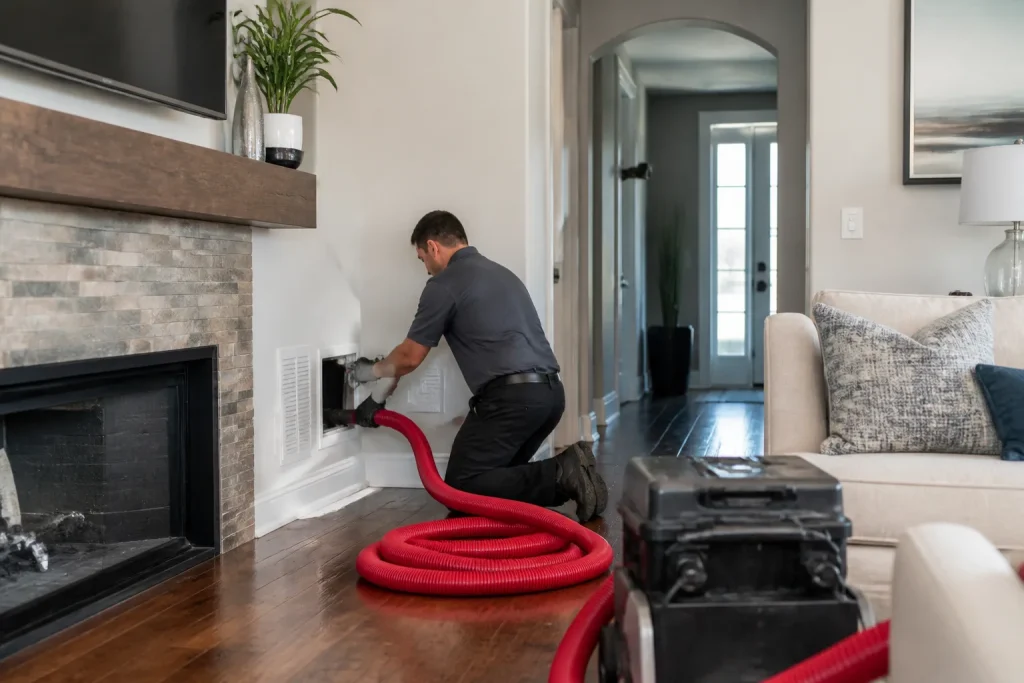
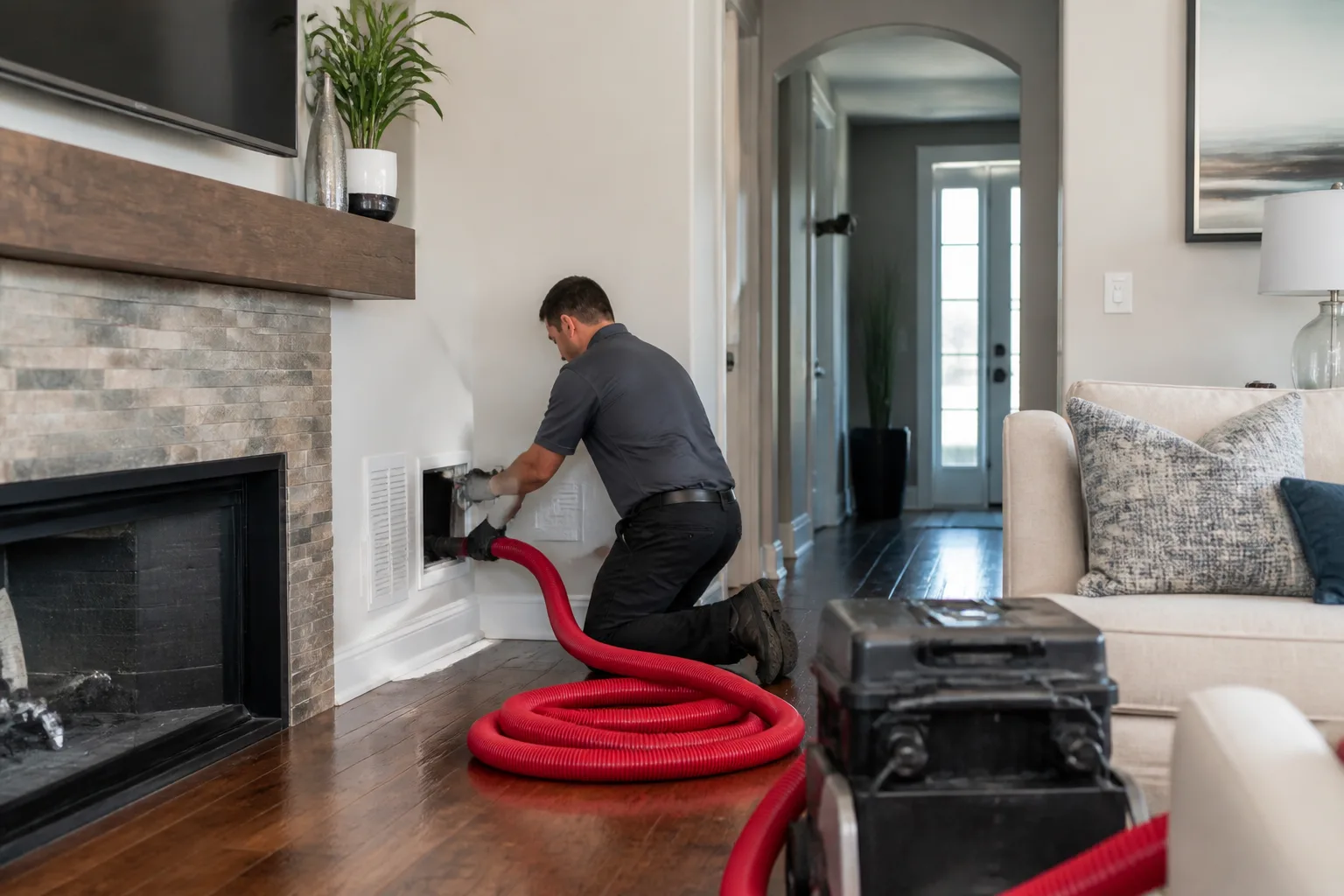
Aprilaire Air Duct Cleaning in Costa Mesa: A Homeowner’s Guide
If you paid for an Aprilaire whole-home air purifier or ventilation system and your duct cleaning contractor doesn’t know the difference between a Model 2410 and a 5000 series, they’re probably not cleaning the system correctly, and they may be bypassing the filtration component entirely. An Aprilaire setup is a different animal from a standard HVAC network. Cleaning it well means understanding how the media cabinet, the fresh-air intake, and the humidifier tie into the air handler. This guide covers what a proper job looks like in Costa Mesa, and the questions worth asking before anyone puts a vacuum to your ductwork. If you’d rather not vet contractors yourself, call (877) 492-3292.
What’s actually different about an Aprilaire system?
The short answer: Aprilaire components sit in the air pathway and change how air moves through your home, so cleaning the ducts without accounting for them leaves part of the system untouched. A standard setup moves return air through a filter grille or a basic slot filter and back to the air handler. An Aprilaire system interrupts that path with hardware: a media air cleaner cabinet mounted to the furnace, sometimes a bypass or fan-powered humidifier tied into the supply plenum, and in many homes a fresh-air intake feeding an ERV or HRV.
Each of those pieces collects something different. The media cabinet holds a large pleated filter that loads from one side. The humidifier’s water panel scales up over time and can send mineral dust downstream. The ERV intake run draws in outdoor air and has its own core and filters that need attention. A technician who only cleans the supply and return trunks will miss all three.
That’s the gap we see most often. A crew runs a whip through the main lines, tells the homeowner it’s done, and drives off with the Aprilaire cabinet still holding a spent filter and the ERV core still crusted with debris. The ducts are cleaner. The air pathway isn’t.
Here’s what should be on the checklist for any Aprilaire-integrated home:
- The media cabinet interior and the filter slot, cleaned before a new filter goes in
- The fresh-air intake duct run feeding an ERV or HRV, brushed and extracted
- The humidifier’s water panel, distribution tray, and the duct section downstream of it
- The ERV/HRV core, which is serviced rather than replaced, along with its own inline filters
- The main supply and return trunks, branch runs, and registers
If a company skips the first four items, they’ve done half a job on a system that costs considerably more than a basic furnace.
Media filters vs. electronic air cleaners: why the mix-up costs you
Aprilaire makes two families of whole-home air cleaners, and they need different treatment. Confusing them leads to either under-servicing a filter that should have been changed months ago or replacing an electronic cell that only needed a wash. The common media cabinets you’ll run into around Costa Mesa are the 410, 413, and 416 series, which take a large pleated filter that loads in the cabinet. Electronic air cleaners use washable cells that collect particles on charged plates.
For the media units, the filter is the maintenance item. It captures everything the return air carries, and once it’s loaded, airflow drops and the blower works harder. Most homeowners can change a media filter themselves; the reason to have it handled during a duct cleaning is so the cabinet gets wiped down and the slot gets cleared of the dust that builds around the edges after a filter change.
Electronic air cleaners flip the logic. The cells are reusable and get washed, not replaced, and a technician needs to know whether the unit is actually energizing after it’s put back together. We’ve seen cells reinstalled wet, or plugged into the wrong slot, and the homeowner never knows the unit is running dead until the next allergy season.
Be specific with whoever you hire. Tell them the model number. Ask whether they service that exact product line, and whether they carry or can source the correct replacement media. An Aprilaire cabinet takes an Aprilaire filter; a generic pleated panel cut to fit will leak air around the edges and defeat the purpose of the cabinet.
How does Costa Mesa’s humidity affect an Aprilaire humidifier?
Costa Mesa runs on the dry side through much of the year, and that’s exactly why a lot of homes here have a whole-home humidifier tied into the Aprilaire system. The problem is water. Any humidifier that evaporates water leaves minerals behind, and those minerals build up on the water panel and the distribution tray. Over time, scale flakes off and gets carried into the supply duct downstream of the unit.
Standard duct cleaning doesn’t fix that. A vacuum and a brush will pull loose debris from the trunk, but the mineral deposits clinging to the duct wall past the humidifier need contact agitation, and the humidifier itself needs the panel replaced and the tray cleaned. If the panel is neglected, the humidifier stops humidifying and starts acting like a dust source.
This is one of those spots where a contractor unfamiliar with Aprilaire humidifiers will simply clean around the unit. What should happen:
- The water panel gets replaced, not just rinsed
- The distribution tray and drain line get cleared of scale
- The supply duct section downstream of the humidifier gets agitated and extracted, not just vacuumed
- The humidistat is checked so the unit runs when it’s supposed to
Rotobrush contact-vacuum equipment handles the duct side well because the brush agitates the mineral crust before extraction. A suction-only rig won’t loosen it.
What changes when you clean a system with an Aprilaire ERV or HRV?
The fresh-air intake run makes an ERV or HRV job different in two ways: it introduces an outdoor air path that has its own filters and core, and it needs to be isolated during cleaning so you don’t pull debris into the unit. An ERV brings in fresh outdoor air and exhausts stale indoor air while transferring heat and moisture between the two streams. That means two duct runs and a core assembly sitting between them, all of which collect dust and, in a dry climate, a fair amount of grit.
The correct order of operations matters. Before any negative-air extraction starts on the main duct system, the ERV or HRV should be isolated so the vacuum doesn’t draw contaminant-laden air through the core and back into the home. The intake run is then cleaned separately with a brush and vacuum sized for a smaller duct, and the core and inline filters are removed, washed, and reinstalled dry.
After the work, the unit should be checked for airflow and balance. If the ERV was pulling its weight before the cleaning, it should still be pulling its weight after. The homeowner shouldn’t have to guess.
Our technicians have up to 14 years of experience with these systems, and we use Abatement Technologies negative-air and HEPA filtration tools during service to keep displaced dust contained. Call (877) 492-3292 for a free estimate.
What should you ask before anyone touches an Aprilaire system?
Ask five questions and listen for specifics, not reassurances. The answers tell you whether the contractor has actually worked on Aprilaire equipment or is about to figure it out on your dime:
- Have you serviced this specific Aprilaire product line before? A media air cleaner, an electronic air cleaner, a humidifier, and an ERV are four different jobs. They should be able to name which one they’ve handled.
- Do you carry or source the correct replacement media? For a 410, 413, or 416 cabinet that means the Aprilaire media, not a generic panel.
- How will you isolate the ERV or HRV during extraction? If they don’t have an answer, they’re going to pull debris through the core.
- Will you check the system is operating within spec after cleaning? That means verifying the humidifier runs, the electronic cell energizes, and the ERV moves air. Not just that the ducts look clean.
- What documentation do you provide? Before-and-after photos of the actual ductwork are the simplest proof the work happened.
We work with Honeywell and Aprilaire air quality products, so these are the questions we expect, and the ones we can answer before the job starts. If a contractor can’t tell you the difference between models, that’s your signal to keep looking.
When to call a pro
Some of this you can handle. A media filter change is a homeowner job, and a water panel swap is within reach for anyone comfortable with a screwdriver. Call a professional when the work goes beyond those parts: a humidifier putting mineral dust into the supply duct, an ERV core that hasn’t been cleaned in years, or a system with visible debris in the trunks. That’s when air duct cleaning done properly, with the Aprilaire components accounted for, makes the difference.
Related services in Costa Mesa: if your concern extends past the ducts, we also handle HVAC cleaning and dryer vent cleaning, so the whole air pathway gets attention in one visit rather than three separate appointments.
The Bottom Line
An Aprilaire system rewards specificity. Know your model numbers, ask whether the contractor has worked on that product line, and make sure the humidifier, ERV, and media cabinet get serviced as part of the cleaning rather than cleaned around. The ducts are one piece of the air pathway; the Aprilaire hardware is the rest of it.
We approach every job as an indoor air quality specialist rather than a duct-only service, using professional-grade Rotobrush and Nikro equipment and sealing any leaks we find in the same visit. If you’re in Costa Mesa and need help, Costa Mesa Air Duct Cleaning Pros offers free estimates – call (877) 492-3292. We answer 24/7. Fast dispatch from 7am to 7pm, Sunday through Friday. You can also start at Costa Mesa Air Duct Cleaning Pros.
Frequently Asked Questions
Most homes should replace an Aprilaire media filter once a year, and more often in dusty conditions or homes with pets, recent renovation, or heavy occupancy. The Aprilaire 410, 413, and 416 cabinets are designed around the media itself, so the filter is the maintenance item and the cabinet only needs a wipe-down when it’s swapped. If airflow has dropped noticeably or the filter looks gray and matted, it’s past due regardless of the calendar.
Not automatically. A standard duct cleaning may not touch the ERV core, the fresh-air intake run, or the humidifier’s water panel, and some contractors clean around these components rather than servicing them. Ask specifically whether the ERV and humidifier will be included, and get it confirmed before work starts. It’s the difference between cleaning the ductwork and cleaning the whole air pathway.
Ask for before-and-after photos of the ductwork and confirmation that the humidifier, ERV, or electronic air cleaner was checked for operation afterward. A humidifier should run when the humidistat calls, an electronic cell should energize, and an ERV should move air. Written confirmation plus photos is the clearest proof the work happened. Call (877) 492-3292 for an exact quote – estimates are free.
Low quotes often skip the Aprilaire-specific components and clean only the main trunks, or they send a technician who doesn’t know the product line. Either way, the price reflects a half job on a system that was designed for more. Ask what’s included, whether replacement media is supplied, and whether the ERV or humidifier is part of the scope. Call (877) 492-3292 for a written estimate and a clear scope.
Written by the team at Costa Mesa Air Duct Cleaning Pros.
Need Air Duct Cleaning Help?
Call Costa Mesa Air Duct Cleaning Pros - the local pro we connect you with is licensed and insured, here with fast help in Costa Mesa.
(877) 492-3292